Showing posts with label West Africa. Show all posts

Edward Wilmot Blyden on Liberia


Edward Wilmot Blyden (b. 8/3/1832 - d. 2/7/1912)

On August 3,1832, Edward Wilmot Blyden was born in Saint Thomas, U.S. Virgin Island, West Indies. He is considered by many historians as the father of Pan-Africanism. His writings and speeches are amongst the earliest works on the subject of Africans returning to the continent after the impact of the European Trans-Atlantic slave trade, even predating the influence of the late Marcus Mosiah Garvey, Jr..

Blyden was an educator, writer and diplomat who became very active in the United States and in West Africa. He is noted to be among the first three Africans admitted to Harvard Medical School. He would later become an active political figure in Liberia, the West African nation settled by free and freed Africans primarily from the Americas and West Indies.

When he married Sarah Yates, of the prominent Yates family of Liberia, he would be joining the prominent family of Beverly Page Yates, the Liberian vice-president from 1856-1860. The Blydens had three children. 

While in West Africa, Blyden also taught in Sierra Leone where he became an influential intellectual force. A frequent commentator on the political and historical actions of African nations to their global diaspora, Blyden spoke publicly on Ethiopia's win on November 16, 1875 at the Battle of Gundet against an Egypt led by colonial Arabs. Both Blyden and his contemporary, Martin Robinson Delany, praised the Gundet win as an African victory.

A Pan-African Perspective of the Battle of Gundet, Ethiopia
Below is one of the many public speeches by Edward Wilmot Blyden. Published July 27, 1857, this speech addresses some of the pressing issues facing the new settlers at Liberia -- many of whom were newly freed from the Americas. Blyden addressed the problem that arises when a populace is driven by a desire to be "rich", as seen by the conspicuous consumption patterns Blyden notes in the new inhabitants to Liberia. In this speech, Blyden also brings to the forefront of his listeners the economic perils ofdependence on the foreign aid of the United States.
* * * *
 Liberia as She is; and the Present Duty of her Citizens  

[An Independence Day address given at Monrovia, July 27, 1857     
African Repository, November 1857, pp. 328-32.] 

 What then…are the moral causes of the present evils in Liberia? …    … as a people we have been in too much haste to be rich. Relinquishing the pursuit of those attributes that would fit us for the faithful discharge of our peculiar duties as men, as Liberians, as an infant nation, we have used every possible measure to enhance our pecuniary importance; and in the precipitate efforts at wealth, we have not been careful as to what means we have employed. The desire to be rich, or to appear to be rich, pervades all classes. The love of money…has grown upon us to such a degree that all other avenues of distinction seem but trifling in comparison of those which lead to the acquisition of money.    To be rich seems with many “the chief end of man”.  Hence, no talents, no endowment of the mind, no skill or knowledge, no amount of education, is appreciated only so far as it will pay…. This fact has operated greatly in retarding the literary progress of our youth….  

CONSPICUOUS CONSUMPTION   

Another cause of our adversity may be seen in the unjustifiable extravagance in which we indulge; in that luxury of expenditure for houses, for dress, for furniture, for food, constantly made the reprehensible remark by thinking foreigners.  We are in dreadful error in regard to our country, if we suppose we are truly prosperous. Our prosperity is not real; it is false; it is fictitious.  The prosperity of a nation is real when the springs of the prosperity are contained within itself, in the hands of its citizens; when it depends for its existence upon its own resources; when it is independent.  But this is not the case in Liberia.  We are, as a nation, upheld by foreigners. We are entirely dependent upon foreigners for our schools, for churches, for preachers, for teachers.  Most of the talent of the country is in the employ and at the control of foreigners.  Those thus employed must ever hold their talents and their efforts subservient, not to what they conceive to be the interests of their country, but to the desires and direction of foreign employers…. What we wish to bring before our minds today is the humiliating fact, that nearly all the talent of Liberia—talent not in ordinary men, but in our principal men—is supported by foreign means and controlled by foreign influence.  And yet, in the face of these humbling realities, we boast of our civilization, of our prosperity, of our independence, and indulge in unjustifiable extravagance…    *     *     *    … the money lavished upon houses, which add nothing to  health and comfort; upon dress, which does not increase the dignity and beauty of personal appearance; the large sums laid out in expensive furniture, … the great amount consumed in the luxuries of the table would go a great way in keeping our streets clear of weeds, in felling the dense forests around us, in reclaiming the wilderness, in cultivating the soil, in civilizing our … brethren.    … Look at the numbers who … in order to advance to, or maintain this [extravagant] style of living, flock to the fostering arms and sheltering wings of these [foreign] societies.  Thus dis- honesty stalks abroad under the semblance of piety; and impiety assumes the appearance of religion for the sake of gain.  And … this extravagant manner of living…are made in the minds of many the standard of respectability…we attach more importance to display than to reality.  There is very little that is substantial about us…    *     *     *    …It is our duty to learn that there are other objects of infinitely greater importance than wealth in our rising country…A higher destiny is ours: our duty and privilege is the laying of the foundation of future empires in Africa…    … It is our duty to curtail our superfluous expenditures.  There should be retrenchment of our expenditures for splendid edifices….Let our surplus means be beneficially expended; let it be vested in the improvement of our country, in placing our prosperity upon a safer and more permanent foundation—in rendering ourselves independent…    … It is our duty to labor.  We dwell in a country rich in resources, which with little exertion can be called forth in sufficient variety and abundance to render us comfortable and independent. But there is a fatal lack of productive industry among us…. The commerce of the country has always been in such articles as our citizens have had no part in producing; hence we acquire wealth from this source without helping to create it.  We purchase the palm oil and camwood and ivory from the natives giving them in exchange articles of foreign production …. The prosperity arising from our commerce is almost as evanescent as that based on missionary appropriations.  Foreigners on the one hand, and the natives on the other, are our supporters.    *     *     *    … we must either abandon our state of utter dependency upon foreigners, by creating the means of supplying our own wants, or relinquish our profession of liberty as a nation.  A state of dependency is entirely incongruous with a state of liberty….    …The…rich and fertile soil…invites us to its cultivation. Nothing should be allowed to interfere between us and the soil…

A West African Folktale of the Story of Oshún's Flight to Olodumare

Oludumare is one of three manifestations of the Supreme God in the Yoruban pantheon
 It has been said in the sacred stories of our West African Yoruba tradition that Oshún (sometimes written Oshun or Osun) is the only Orisa able to approach Olodumare (aka Olorun) directly, carrying prayers from the mouth of humanity to Olodumare's ears. This is the story of Oshún's flight and how she became the messenger of Olodumare. 

In the early days of the world, and of Ilé Ifé, the orishas became tired of serving Olodumare. They began to resist the Lord of Heaven's edicts and to even plot the overthrow of Olodumare's kingdom in heaven and earth. They felt they didn't need Olodumare and that as the Lord of Heaven was so distant anyway, they could merely divide the aché or powers among themselves and that things would go much better that way.

When Olodumare caught wind of this attitude and their plots, the Lord of Heaven acted simply and decisively. Olodumare simply withheld the rain from the earth. Soon the world was encompassed by a staggering drought, the ground became parched and cracked, the plants withered and died without water. And it wasn't long before all on earth, orishas and their children alike began to starve.

After a short time, growling bellies and sallow faces began to speak louder than pride and rebelliousness. They unanimously decided to go to Olodumare and beg for forgiveness in hopes that this would bring rain back to the world. But they had a problem: none of them could reach the distant home of Olodumare. They sent all the birds one by one to attempt the journey but each and every one of them failed, tiring long before reaching the palace of the Lord of Heaven. It began to appear that all hope was lost.
 

Then one day, the peacock, who was in reality Oshún herself, came to offer her services to save the world from this drought. Once again, there was general upheaval and even more laughter as the orishas considered the idea of this vain and pampered bird undertaking such a courageous and dangerous journey. "You might break a nail," said one.
 
But the little peacock persisted. As they had nothing to lose, they agreed to let Oshún go on the world's behalf. So the little peacock flew off towards the sun and the palace of Olodumare. Oshún soon tired of the journey, but she kept flying ever higher, determined to reach the Lord of Heaven and to directly plea for the world.

Going yet higher, Oshún's feathers began to become scraggly and black from the withering heat of the sun, and all the feathers were burned from her head.
 
But she kept flying.
 
Finally, through sheer will and determination she arrived at the gates of Olodumare's palace. When Olodumare came upon her she was a pathetic sight. Oshún had lost much of her feathers and the ones that remained were black. In all truth, Oshún was looking quite scraggly. To get to heaven she had to fly so close to the sun and sacrifice her beautiful feathers. The Lord of Heaven took pity on Oshún and brought her to the Palace where she was fed and given water, and her wounds were treated.

He asked Oshún why she had made such a perilous journey. She explained the state of earth and went on to tell Olodumare that she had come at risk of her own life so that humanity might live.
 

Olodumare looked to the world. He then looked to Oshún's plaintive face. It was obvious that everything she had said was true and he was moved by Oshún's capacity to love. The Lord of Heaven turned to the peacock, who wasn't a peacock anymore. The flight for humanity turned Oshún's outer form into that of a vulture. He ordered the rains to fall from heaven.

Then Olodumare looked deeply into Oshún's eyes and into her heart, then announced that for all eternity she would be the Messenger of the House of Olodumare and that all would have to respect her as such. From that day forward, in this path, Oshún became known as Ikolé, the messenger of the House of Olodumare. Ikolé also is the name for the vulture in Lacumí. And from that day the path of Oshún known as Ibú Ikolé was revered and became associated with her bird, the vulture. The vulture then returned to earth, bringing with her the rain, where she met with great rejoicing.

As benefits a Queen or Iyalodde,
Oshún graciously refrained from reminding them of their jibes and abuses as she could see the shame on their faces. This is why, whenever a person is to become initiated as a priest in the Yoruban religion, no matter which orisha they are having seated in their heads, they must first go to the river and give an account of what they are to do -- as Oshún is the Messenger of Olodumare.

The Language of Symbols in Africa

Spider web symbol for wisdom in West Africa, Ananse
Symbols are visual keys that have meaning to people with a common heritage around a given symbol. The Gospel of Saint Philip states that "truth did not come into the world naked, but it came in types and images. One will not receive the truth in any other way."

Important iconic symbols arose in many human groups across the globe. The symbol was designed to communicate and precisely remind its viewer of concepts in the world. They may serve as roadsigns, maps or instructionals for the viewer. Not surprisingly, symbols have had a deep impact on human psychology and spiritual life, relaying the intuitive wisdom of the ancients.

In Africa, where record of the oldest human communities lie, there are many tribal families that use symbols to tell stories and provide information, reminders and lessons. These symbols are considered sacred, and were primarily used in ceremonial and religious contexts.

EAST AFRICAN SYMBOLS

Among the oldest form of surviving written script is a symbolic one -- hieroglyphics, a mixture of symbols and signs. Some pictures within a hieroglyphic may easily be recognizable to a viewer as acts of humans or human-made objects. Some symbols convey very specific meaning that will be unknown to an outsider who has not studied the meaning of the image within the context it was initially relayed. Other symbols within hieroglyphic writing have phonetic value.

An important symbol in ancient Egyptian hieroglyphics is the ankh, represented here. The ankh combines the symbols of Osiris (the T cross) and Isis (the oval) to symbolize immortality. Osiris and Isis -- brother and sister-- were the two earliest God and Goddess in ancient Egyptian tradition. Isis is the first ancient Egyptian goddess to appear in surviving East African cultural history. Isis represents the divine mother and protector. She is also depicted in ancient Egyptian symbols as a kite, a form assumed to search for the dismembered body of her brother Osiris. 

The patriarchal Christian cross borrowed it's iconography from the older ankh symbol, removing the female Isis representation. The ancient Egyptian ceremonies often depict gods ceremonially carrying the ankh, much like the Ethiopian Orthodox Christians use the cross symbol in its processionals.

The goddess Isis gives pharaoh Seti I breath of life, in the form of an ankh
Other Nile Valley symbols were the sun disk and the pyramid. The winged-sun disk symbol represents the sun god Ra. Ra rules the sun and the skies, as the creator of the world. The pharaohs (kings) honored Ra as sons (suns) in their iconography. Ra is said to have resided in Heliopolis, an ancient Egyptian city. The symbol for Ra and his attributes is the obelisk and the sun rays. The pyramid represents another important East African symbol. The ancient Egyptians used the pyramids for initiations into the mystery schools, as well as homes for those who transcended through the duat. It symbolizes the highest level of spiritual attainment, an ascent of the hierarchy of enlightenment.

WEST AFRICAN SYMBOLS

There were also many symbols used in West Africa to convey messages and values within community. The Akan and the Asante tribes of West Africa both use Adinkra symbols. The symbols are found frequently in the West African country of Ghana. The symbols are incorporated into fabrics and on interior wall designs, or on pottery.


Used frequently by pre-colonial Ghanaian people, the Adinkra stamps were made from gourds and used to convey important concepts. These symbols may show up in jewelry designs to convey meaning to those within the culture as clearly as phonetic text represents meaningful words to those who are native to European languages, such as English.

For example, in Ghana the aya or "fern" adinkra symbol represents endurance and resourcefulness. "An individual who wears this symbol suggests that he has endured many adversities and outlasted much difficulty," states W. Bruce Willis in his book The Adinkra Dictionary. The aya represents a known West African plant that can grow in difficult places. It can withstand dry soil and diverse weather conditions and soon came to represent human perseverance in life. Among the Ghanaians, this is a symbol of hardiness, endurance and defiance.


Africa’s rich and diverse artistic traditions vividly express a spiritual view of the world. The number of symbolic systems in Africa is beyond this writer's capacity to fathom, based on the significant cultural diversity within the African continent. Symbols may arise on masks and ornaments, within architectural designs or in hairpieces and clothing. From East Africa to West Africa -- Southern Africa to Northern Africa -- the people of Africa have a wide array of symbols waiting to be examined by those interested in learning more about African history and its ancient, diverse cultural heritage. 

Garifuna: Africans in St. Vincent, Caribbean and Honduras, South America

Image of Joseph Satuye (aka Joseph Chatoyer), Chief of the Black Caribs aka Garifuna.

The millions of Africans living in Central America, South America and the Caribbean - in Spanish language nations - are among the most rich examples of African cultural survival in the so-called New World. The Garifuna represents a very unique example of an early African community to the Americas that held a firm grip onto African kinship and cultural ties.

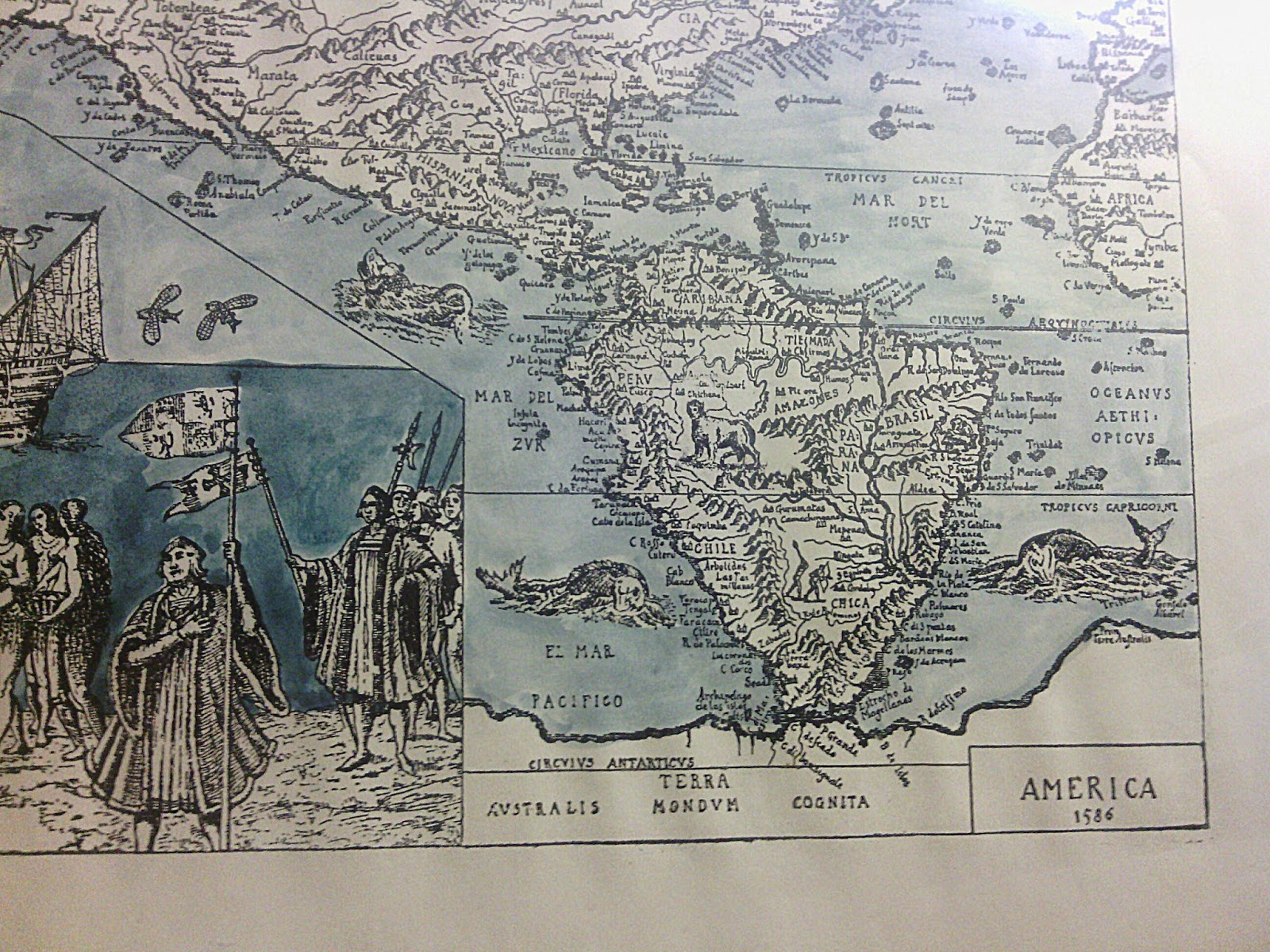
No Garifuna nation will be found on a map today, but there are some old maps that represent a region in northern South America by the name of "Garibana." Here is the image of one such map found in a vintage shop in Southern California.

Partial image of map dated 1586 representing America.


Zoom image on 1586 map representing region described as "Garibana."
Some commentators report that the Garifuna were in the Americas as early as the 1300s, migrants from the West African Mali Empire. See GAHFU, Inc., Garifuna History. See also African Kingdoms: Medieval Warfare Between Ghana and Mali Empires (Mansa Musa chronicles travel tales from Mali Empire to East Africa and Middle East cir. 1300 C.E).

Other commentators argue that the Garifuna arrived from ship-wrecked European slave ships that landed on the island of St. Vincent (aka Saint Vincent, San Vicente) as early as 1635. A lay historian from Greater-Accra, Ghana, Kwekudee, asserts they may be kin to the Akan Fante people of West Africa. Kwekudee considered factors such as the Garifuna's matrilineal inheritance system, their dancing styles and their food, with the staple food being cassava.

Photo: The Chief Joseph Chatoyer Garifuna Folkloric Ballet of New York.

Central to the Garifuna culture is a strong collective identity as a people. The Garifuna have their own unique Garifuna language, music and cuisine. The spiritual tradition of the Garifuna centers around an ancestral reverence, honoring the wisdom of the ancestors they have relied upon for survival for centuries. Like many African communities adjusting to slavery and the lost of family and tribal kinship ties, the rhythms of the drum and dance would help to create common songs around a common struggle. This reunified families and villages torn from their traditional homelands in Africa.

The Island of St. Vincent

The Arawak and the Kalinago were the native inhabitants of St. Vincent at the time Africans began to arrive. The Kalinago, known generally as the Caribs (hence Caribbeans) by the Europeans, intermarried with the Africans, as did the Arawak. The population of natives to the island refused to return Africans to European slavers, according to the accounts of Jean-Baptiste Labat, a Jesuit priest who lived in the Caribbean colonies at the turn of the 1700s. Historical accounts report Africans escaping European slave plantations in the Caribbean for St. Vincent by canoes and rafts. By the 1700s the mixed community of Africans and native peoples on the island of St. Vincent had increased and the people became known as the Garinagu (later Garifuna).

By 1763, under the Treaty of Paris, all European claims to the island of St. Vincent was ceded to the British. The British would have to go in, however, to actually take possession over an island populated by free people. The warrior-leader of the Garifuna was Joseph Satuye. For decades, Satuye organized the Garifuna as African Maroons in war against the colonial British mission.

The British forces, however, overwhelmed the Garifuna after many decades of battles. By 1797, there was a final surrender by the Garifuna. According to the GAHFU, to this day the Vincentians "make an annual pilgrimage to the island of Beliceaux to pay homage to the Garifuna people who were imprisoned on that island where half of the population died of Yellow Fever, other diseases and starvation."

The Island of Roatán, Honduras

According to the Bay Island Diver, A diver's guide to the Bay Island of Honduras, the origins of the Garifuna in Honduras was the result of the following.
One group of slaves was "parked" here during this time during the heat of a battle (between the Spanish and British). When the winners came to collect them, the slaves refused to go. These are the Garifunas who populate much of the Bay Islands to this date, still maintaining their own cultural identity and language. Punta Gorda on Roatán is one of many villages where they still make their homes. 
While the British defeated the Garifuna in St. Vincent, they could not enslave them. An attempt at enslavement would certainly have led to an unending and continuous effort at revolt on the island the Garifuna knew very well. Instead, the British imprisoned Garifunas on the island of St. Vincent and literally exiled populations of the Garifuna from St. Vincent to the Honduras coastal island Roatán (aka Ruatan, Rattan). The British may have sought to establish a new slave plantation from the Garifuna labor in Honduras, but fortunately it was without success.

The Garifuna people would not know slavery in Honduras, only poverty. The Garifuna would grow their populations from Honduras and expand among the coastal nations of the Americas -- with populations of Garifuna now living in Belize, Nicaragua and Guatemala. Today, the Garifuna are present in Central and South America, as well as across the Caribbean and the United States.

 The Garifuna Heritage
"One of the unique things to me about the Garifuna spirituality is that the sacred and the profane seems to exist simultaneously. In the western understanding of religion and spirituality, that could never happen." 


Video: A documentary film produced by the National Garifuna Council of Belize.
 The film addresses Garifuna Culture including ritual, music, dance and language.

A Story About the Garifuna Documentary
"This is what our ancestors have left for us and this is what God has given to us, our own culture."

 "We have a huge battle to rescue what is ours again. And we have to do it. And we can do it."
- Jorge Castillo, Tornabe, Honduras

 
Video: This film chronicles the challenges and struggles of the Garifuna people to preserve their identity. A Ben Petersen Film A Brigham Young University Communications Department Production.

African Kingdoms: Medieval Warfare Between Ghana and Mali Empires

In 1230 C.E., the western Africa Ghana Empire fell under the warfare leadership of Sundiata Keita, leading to the rise of the Mali Empire in West Africa.

According to the Epic of Sundiata, the national epic poem of the Mali Empire (also referenced as Mandinka, Manding Empire, Manden Kurufa, Mandingo people, Mande language), the Mali federation of nation-states included nearly all of the land between the Sahara Desert to the coastal borders of the modern day nations of Gambia, Guinea-Bissau, Guinea, Mali, Mauritania, and Senegal. The Mali Empire would control most of west Africa for two centuries.

Sundiata Keita's Medieval Warfare in West Africa

Sundiata Keita, also known as Sogolon Djata or Mansa Sundiata, was from the Keita clan and born in the village of Niani near the modern day borders of Mali and north-east Guinea. The loosely federated Mandinka kingdoms were ruled by the medieval Ghana Empire (cir. 790 C.E., also known as the Wagadou Empire) under King Soumaoro Kanté during Sundiata’s youth. The modern country of Ghana shares no territory with the medieval Ghana Empire, though some of its inhabitants claim ancestral lineage with the inhabitants of the mediæval empire.

Mandika Kingdom-States Battle the Ghana Empire

Sundiata devoted his life to the overthrow of the Ghana Empire and was exiled after waging war against the medieval Ghana Empire by mobilizing the loosely federated Mandinka kingdom-states. In 1230 C.E., Sundiata led a rebellion against King Soumaba Cisse from the then Kangaba kingdom-state in the south-western region of the modern day Mali nation's Koulikoro Region. Kangaba was then an important gold mining region among the Mandinka kingdom-states.

The Battle of Kirina near the Koulikoro Mountains of Bamako, Mali

Medieval West Africa was ruled by three major empire nations, the Ghana, Mali and Songhai. These kingdoms were part of a region historically referred to as the Western Sudan, which extended from the Atlantic Ocean to Central Africa. Trade routes were numerous across the Western Sudan region.

In 1235 C.E., Ghana Empire forces were led by the Sosso region king Soumaoro Kanté, also known in historical accounts as Sumanguru Kanté. Soumaoro converged at the Koulikoro Region of modern day Bamako, Mali in an important battle with the Mandinka forces. The historic African military Battle of Kirina is cited by historians as the final defeat of the mediæval Ghana Empire. Military legend provides that Soumaoro was not killed but disappeared into the Koulikoro mountains of Bamako.

Sundiata was crowned Mansa or "King of Kings.” His three sons succeeded him to the throne of the Mali Empire: Mansa Khalifa Keita, Ouati Keita and Wali Keita. The famous tales of Mansa Musa (b. 1307 C.E.), the son of Sundiata's brother Abu-Bakr, chronicles his travels and trade to distant lands in East Africa and the Middle East. While part of the royal kingdom family of the Mali Empire, Mansa Musa's grandfather Abu-Bakr and father Faga Laya did not ascend the Mali Empire throne as Mansas.

Mansa Musa Rules Mali Empire and Travels to Mecca

According to Ibn-Khaldun's history of the Malian kings, Mansa Musa’s legendary caravan across Africa from Timbuktu to Mecca occurred in 1324 C.E. The historical accounts provide that Mansa Musa traveled with a band of 60,000 people; 12,000 slaves; 500 workers; 300 pounds of gold; and the nation’s foremost poets, artists, and scholars.

While the year of Mansa Musa's death is debated among modern historians, his reign is generally thought to have lasted about 25 years. The recorded rule of Mansa Musa’s son Mansa Maghan was from 1332 to 1336 C.E.. Mansa Suleyman, Mansa Musa’s older brother, ruled the Mali Empire from 1336 to 1360 C.E..

Further reading:

“The Thirteenth and Fourteenth Century Kings of Mali,” by N. Levtzion, The Journal of African History, Vol. 4, No. 3. (1963).

The African Renaissance Monument in Dakar, Senegal


The African Renaissance Monument, Senegal, Africa. 


The African Renaissance Monument, also referred as Monument to the African Renaissance and
Monument De La Renaissance Africaine, is a bronze statue perched on a hill in Dakar, Senegal. The representation of a man, woman and child emerging from a volcano was inaugurated at a ceremony on April 3, 2010, featuring hundreds of drummers and dancers. The African Renaissance Monument stands erect against the West African skyline in Senegal at 164 feet high, taller than the Statue of Liberty in the U.S.A.
 
Marking 50 Years of an Independent Senegal

 
The unveiling marked Senegal's 50 years of independence. Senegalese President Aboulaye Wade has said he hopes the public monument will attract tourists to the West African country, and defended the public monument in writing, stating “[t]his African who emerges from the volcano, facing the West ... symbolizes that Africa which freed itself from several centuries of imprisonment in the abyssal depths of ignorance, intolerance and racism, to retrieve its place on this land, which belongs to all races, in light, air and freedom.”

“It's impossible to miss Senegal's new 160-foot (49 meters) African renaissance monument,” wrote NPR reporter Ofeibea Quist-Arcton. “Perched high on a hill, the mighty Soviet-style bronze statue of a man, woman and child overlooks the Atlantic Ocean and dominates the horizon of the capital, Dakar.”

Public Monument Creates Controversy

President Wade authorized the public works project in the capital of Dakar, described by some as an African Eiffel Tower and others as a work that should never have been commissioned. Its $27 million dollar (£17m) cost and style stirred complaints from many in the predominantly Muslim country.

Ndeye Fatou Toure, a member of the Senegalese Parliament, said the statue was an “economic monster and a financial scandal in the context of the current crisis,” noting that half of Senegal's population lives below the poverty line. Additionally, the choice of garb for the African family was seen as an affront to the Muslim sensibility of public discretion.

Ebrima Sillah, a Senegalese journalist, stated that many Senegalese fine artists took offense that Wade commissioned a crew of 50 North Koreans to construct the public sculpture. President Wade made a public statement that he chose the North Korean crew because they were known as experts in constructing large public monuments.

African Statue Draws Pan-African Delegates
 
Aerial Photo: Monument to the African Renaissance

Nineteen African heads of state attended the unveiling ceremony in Dakar. Notable public dignitaries included Bingu wa Mutharika, the Malawian and African Union president, as well as the African presidents of Benin, Cape Verde, Republic of Congo, Ivory Coast, Gambia, Liberia, Mali, Mauritania and Zimbabwe. Additionally, a delegation of 100 African-Americans attended the ceremony, including Reverend Jesse Jackson and Senegalese-American singer Akon.

“It brings to life our common destiny,” said President Wade at the unveiling ceremony, according to a Reuters report. “Africa has arrived in the 21st century standing tall and more ready than ever to take its destiny into its hands.”

After 40 years as president of Senegal, the 83 year old Wade announced that he will seek re-election in 2012. With close links to Washington D.C., the peanut and fish exporting former French colony has been cited for decades as an example of African democracy. In September 2009, Senegal was awarded a $540 million grant by the U.S. federal government to encourage its continued good governance.

References:
  • "Senegal unveils 'African Renaissance' statue," by Mark John and Richard Valdmanis, Reuters (4/3/10)
  • "For Many in Senegal, Statue Is a Monumental Failure," by Ofeibea Quist-Arcton, NPR (1/5/2010)

African Nova Scotian: Black Cultural Centre for Nova Scotia


BLACK CULTURAL CENTRE FOR NOVA SCOTIA -- If you find yourself in Nova Scotia, make sure you visit the Black Cultural Centre for Nova Scotia. In December, the Black Cultural Centre hosts its Annual Christmas Concert.

  • Location: 10 Cherrybrook Road, Dartmouth, Nova Scotia
  • Phone: (902) 434-6223 or (800) 465-0767
  • Fax: (902) 465-0767
  • Website: bccns.com
  • Hours of Operation: Open year-around: Monday-Friday, 9:00 a.m. - 5:00 p.m.; Saturday, 10:00 a.m. - 3 p.m., June-September
  • Admission: Adults $6, seniors & students $4, family $20.

Photo: Portrait of a Nova Scotian of African descent attributed 
to Lady Falkland, 1845. Source: Library and Archives Canada
The Black Cultural Centre for Nova Scotia recently completed its 2011 Museum Renovation Initiative. Located in the oldest Black community in the Halifx metro area, the center includes exhibit rooms, auditorium, library, picnic area and a gift shop. The center's staff also offers bus tours of the local history of blacks in Nova Scotia, dating back to the 1600s. Programs highlight themes related to community life, religious life, military service and migration.

From Nova Scotia, Canada to Sierra Leone, Africa

In addition to the Black Cultural Centre's resources, the local government has also digitized select records of African settlement patterns in Nova Scotia and made them available through a searchable online archive.

The digitized documents available from the Nova Scotia government were originally assembled by the late Records Commission, T.B. Akins, around the theme "Refugee Negroes". Spanning from 1791-1839, the earliest documents relate to the emigration of 1200 free Africans in the eastern region of Canada to Sierra Leone. The group of Africans who left Nova Scotia originally immigrated after the American Revolutionary War, in 1783, as part of the British Loyalist migration.

The documents available from these government archives are great for African diaspora genealogist because they include the individual names of African refugees from the passenger lists of British ships landing at Beechville, Hammonds Plains, Preston and other locations. Documents also include correspondence and petitions to the government by white Nova Scotian citizens expressing concern for the difficult conditions faced by the African refugees.

Black Nova Scotian Refugees from the War of 1812

The Canadian digital archives also include information regarding the settlement of 2000 African refugees in Nova Scotia from September 1813 to August 1815. This migration was a direct result of the British military's War of 1812 proclamation that offered Americans who deserted to the British side free settlement in any of the British colonies if the efforts were unsuccessful.

Unlike the early emigrants to Sierra Leone, the African refugees of the War of 1812 remained, in great part, in Nova Scotia. In 1820, the British colonial government offered to emigrate them to Trinidad. Archive records indicate that 95 Africans chose to leave for Trinidad. The record also indicates that others feared migrating to Trinidad would lead to a return to slavery.

Searchable archive records of African settlement in the Nova Scotia and emigration to West Africa and the Caribbean are at Nova Scotia Archives, available HERE.

Here's a sample of the youth music out of Nova Scotia.

    Until lions have their historians, tales of the hunt shall always glorify the hunter. - African Proverb

    Abd al Rahman Ibrahima Ibn Sori: From Guinea to the Mississippi Delta


    Image: Abd al Rahman Ibrahima Ibn Sori (aka Abdul Rahman Ibrahim and The Prince) 
    (Born: 1762 - Died: 1829)

    In 1762, Abd al Rahman Ibrahima Ibn Sori was born within a royal family, son of King Sori, in the village of Timbo in what is today known as the Republic of Guinea in the region of Fouta Djallon (aka Futa Jalon, lit. "the land of the Fulbe and Jalunke"). Ibrahima was born among the Fulbe (aka Fulani, Fula, Fullah, Foulah; singular: Poulas, Peul, Pullo) of the Timbo region. The Fulbe were primarily muslim cattle herders in this West African mountainous region where the Niger river rises and runs eastward. In fact, Guinea's mountains are the source of the Niger, Gambia and Senegal rivers, with its highest point at Mount Nimba. 

    Today the cool, mountainous Futa Jallon region runs roughly 
    north-south through the middle of the Republic of Guinea.

    According to the book Prince Among Slaves, written by Professor Terry Alford, the non-muslim Jalunke was the majority tribal group within the Futa Jallon region in Guinea where Ibrahima was born. According to Prof. Alford, conflict within the ethnically pluralistic Fulbe-Jalunke society occurred when the Jalunke leadership announced a declaration forbidding public prayer. Karamoko Alfa, the leading Fulbe cleric, declared jihad against the Jalunke for what was deemed a direct affront to Islam. A ceremonial slashing open of the Fulbe farmer's drums marked the beginning of this great West African war. 

    From Futa Djallon to the Mississippi Delta

    By 1788, at the age of 26, Ibrahima was a military leader within the Fulbe army when he was reportedly ambushed, captured and sold to slave traders. Ibrahima was shipped to the United States where he was eventually sold to a Natchez, Mississippi slave trader by the name of Thomas Foster. Ibrahima's knowledge of agriculture operations and his leadership skills made him a central figure on Foster's cotton plantation. By 1794, Ibrahima married Isabella, also enslaved on the Foster plantation and would have five sons and four daughters.  

    As the story goes, one day Ibrahima was recognized by an Irish surgeon, Dr. John Cox, who had traveled to Timbo during his shipping ventures with an English ship. Cox was aided by Ibrahima's family for six months when he was stranded and fell ill in the Futa Jallon region. Cox asked Foster to sell Ibrahima to him so that he could free him for return to his West African homeland. Mr. Foster refused. Cox petitioned vigorously on Ibrahima's behalf until his dead in 1816. 

    In 1826, a letter Ibrahima wrote in Arabic addressed to his family in West Africa was picked up by Andrew Marschalk, a local newsman who sent a copy to the federal capital in Washington D.C., to the attention of U.S. Senator Thomas Reed. Reed forwarded the correspondence to the U.S. Consulate in Morocco, assuming that Ibrahima was a Moor. Though Ibrahima was not a Moroccan citizen, Sultan of Morocco Abderrahmane was touched by his story and petitioned U.S. President John Quincy Adams to release Ibrahima from the institution of slavery. 

    The Prince Among Slaves Returns to West Africa

    In 1828, Henry Clay, then U.S. Secretary of State, interceded on behalf of "The Prince", the name given Ibrahima by Natchez, Mississippi residents. Foster stipulated that he would grant Ibrahima's legal release from slavery only if he left without his family and returned to Africa. Despite the Ibrahimas' public speaking efforts to raise enough money to purchase freedom for their nine children before leaving for Africa, they raised only half of the money Foster required for the purchase. 

    At age 66, after 40 years in slavery, Ibrahima sailed to Monrovia, Liberia in 1828. By July 1, 1829, a caravan was reportedly en route to Liberia, carrying family members from his Futa homeland. Ibrahima caught a fever and died at the age of 67, never making it to his native village in the Futa Jallon. He died July 6, 1829. His wife Isabella was reunited with two sons and their families whose freedom and transport was financed by the Ibrahima's funds. The remaining family in Mississippi was inherited by Foster's heirs and scattered across the South before further efforts could be made on their behalf. To his legacy, Ibrahima left behind the narrative of his full story, a rare gem within the legacy of the early colonial history of Africans in America.


    Support Our Work by Buying a T-Shirt